Navigating NSPIRE
How property managers can master HUD’s new inspection standards

If you’re a property manager overseeing HUD-assisted housing, NSPIRE is coming—HUD’s National Standards for the Physical Inspection of Real Estate. With full implementation scheduled for October 2025, this comprehensive overhaul of inspection standards is set to fundamentally change how we approach housing quality oversight.
NSPIRE represents the most comprehensive shift in HUD inspection standards in decades. Property managers who don’t prepare adequately will find themselves struggling with compliance and operational inefficiencies when the deadline arrives.
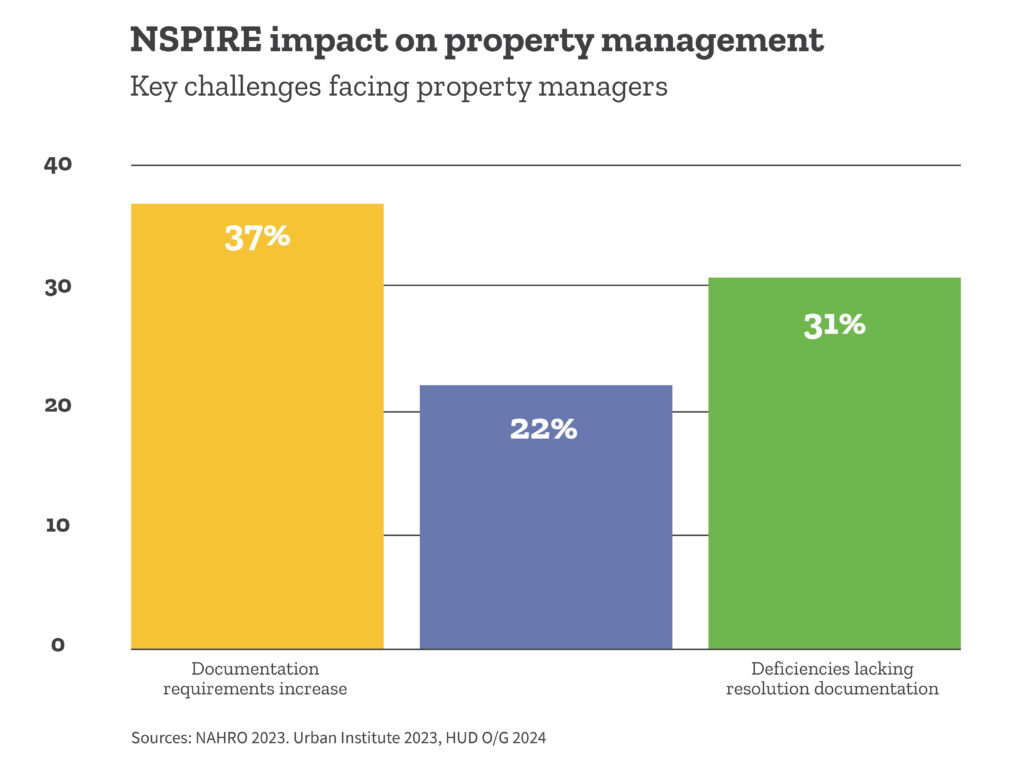
The numbers tell the story. Even under current inspection standards, documentation requirements have surged 37% over the past decade, adding significant administrative strain. With NSPIRE’s implementation scheduled for October 2025, traditional paper-based systems will face even greater challenges. Meanwhile, a 2023 Urban Institute study revealed that 22% of identical deficiencies were classified differently across inspectors—highlighting the urgent need for standardization.
What changed with NSPIRE
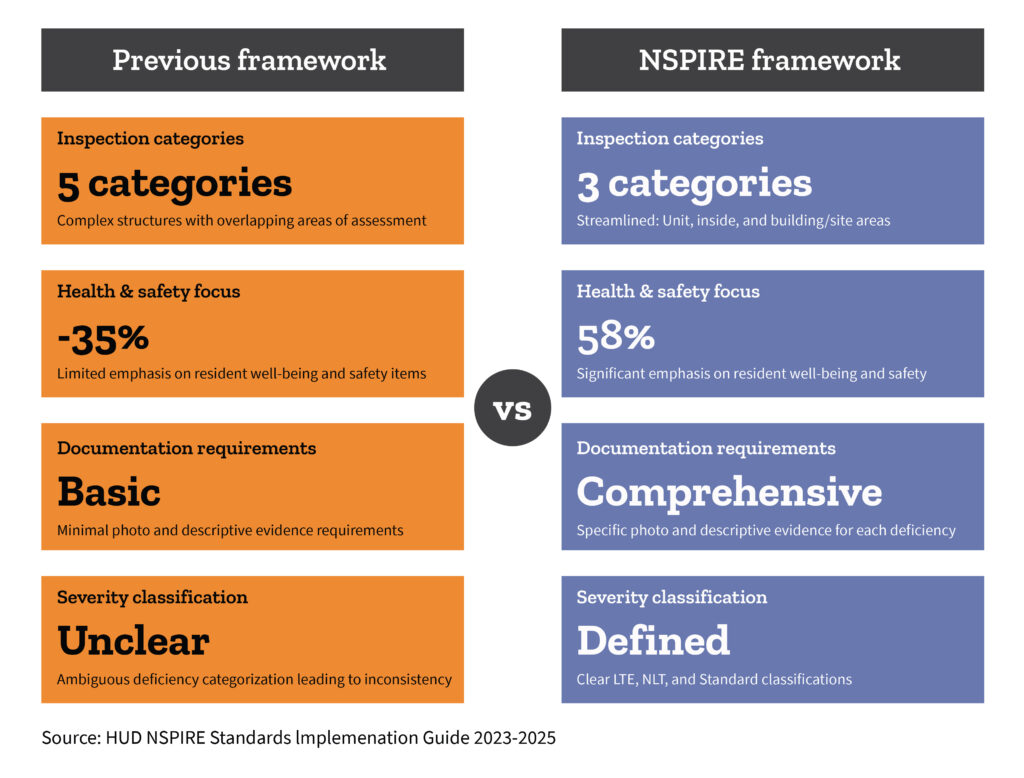
Gone are the days of the old five-category inspection framework. NSPIRE introduces a streamlined approach with just three main categories: Unit, Inside, and Building/Site. But don’t let the simplified structure fool you—this system is far more rigorous.
Key NSPIRE differences:
Health and safety focus: A striking 58% of NSPIRE’s inspection items directly relate to resident well-being, compared to roughly 35% under previous standards.
Severity classifications: Deficiencies are now clearly categorized as Life-Threatening (LTE), Severe, Moderate, or Low—removing much of the guesswork that plagued older systems.
Evidence requirements: NSPIRE demands specific photographic and descriptive documentation for each deficiency type, creating a paper trail that can make or break compliance audits.
Property managers across the industry are already preparing for the transition, recognizing that current inspection processes will need significant upgrades to handle NSPIRE’s documentation demands. Starting preparation now is essential rather than scrambling after the October 2025 deadline.
The pain points property managers face
The upcoming shift to NSPIRE will create several operational challenges that property managers must address:
Documentation overload
Traditional paper-based or basic digital systems struggle with current documentation demands, and NSPIRE’s enhanced evidence requirements will intensify these challenges. The HUD Office of Inspector General reported that 31% of identified deficiencies lack proper resolution documentation—a statistic that can lead to compliance failures and financial penalties.
Inspector inconsistency
Without standardized tools, different inspectors may classify identical issues differently. This inconsistency creates confusion for maintenance teams and can result in misallocated resources.
Follow-up gaps
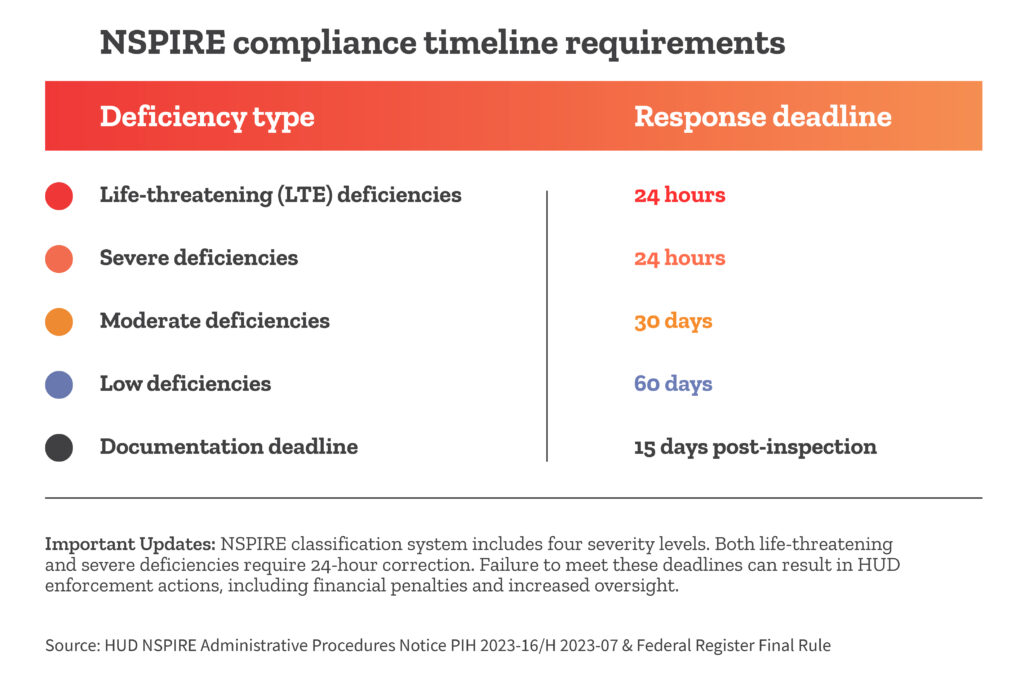
NSPIRE’s timeline requirements are strict. Life-threatening and severe deficiencies must be addressed within 24 hours, moderate issues have 30-day windows, and low-priority items require resolution within 60 days. Missing these deadlines can trigger enforcement actions.
Cost pressures
Many property managers anticipate inspection costs increasing 15-25% due to additional documentation time and potential re-inspections when compliance falls short.
Technology solutions that actually work
Forward-thinking property managers are turning to digital solutions to tackle current challenges and prepare for NSPIRE. The most effective approaches share several key characteristics:
Mobile-first design
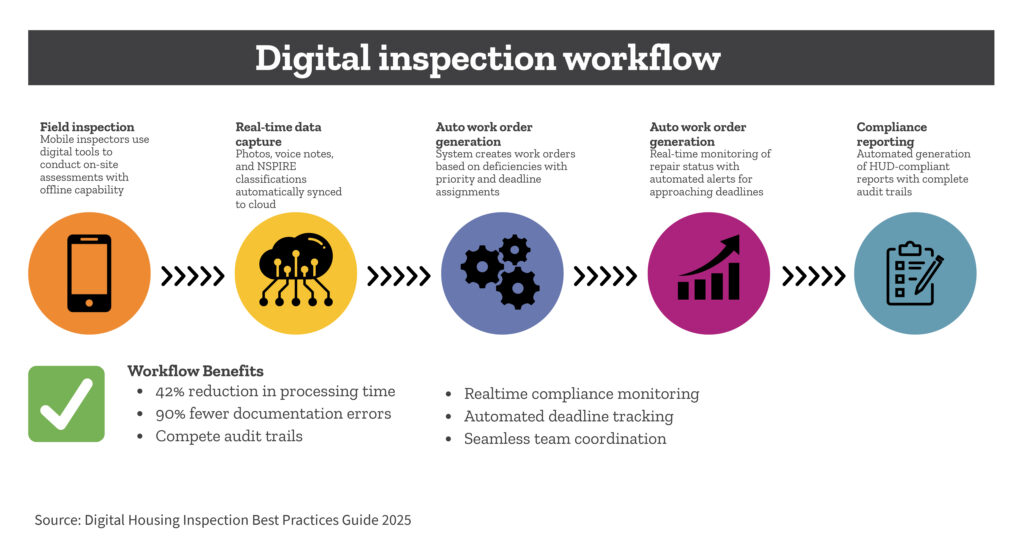
Inspectors need tools that work in the field. Cloud-based platforms with offline capabilities ensure that connectivity issues don’t derail inspections. Look for solutions that allow photo capture, voice-to-text annotations, and real-time data sync.
Built-in NSPIRE logic
The best platforms incorporate HUD’s classification criteria directly into their workflows. This means inspectors receive guidance on severity levels and documentation requirements as they work, reducing errors and ensuring consistency.
Automated workflows
Digital platforms can automatically generate work orders based on inspection findings, track resolution timelines, and send alerts when deadlines approach. This automation eliminates the manual tracking that often leads to compliance gaps.
Data analytics
Smart platforms don’t just collect data—they analyze it. Property managers can identify recurring deficiencies, track maintenance team performance, and even predict likely problem areas based on historical patterns.
Industry data shows that implementing digital inspection platforms can reduce administrative processing time by up to 42% while improving first-time inspection pass rates by an average of 18%.
Implementation best practices
Successfully transitioning to digital NSPIRE compliance requires careful planning:
Start with assessment
Evaluate your current processes honestly. Where are the bottlenecks? What documentation gaps exist? Understanding your baseline helps you choose the right solution.
Plan for integration
Your inspection platform should integrate with existing property management systems. Standalone solutions that require duplicate data entry often fail to deliver promised efficiencies.
Invest in training
The most sophisticated platform won’t help if your team doesn’t use it properly. Budget for comprehensive training that covers both technical skills and new NSPIRE requirements.
Measure success
Track key metrics from day one. Monitor inspection completion times, documentation quality scores, and first-time pass rates. This data helps you fine-tune processes and demonstrate ROI to stakeholders.
The ROI reality
Property managers implementing digital inspection solutions typically see significant returns according to industry research:
- Operational efficiency: Administrative processing time decreases by an average of 42%.
- Compliance improvements: First-time inspection pass rates improve by 18% on average.
- Cost reduction: Repair costs drop 15-25% through better coordination and oversight.
- Documentation quality: Digitally documented inspections are 76% less likely to have documentation deficiencies.
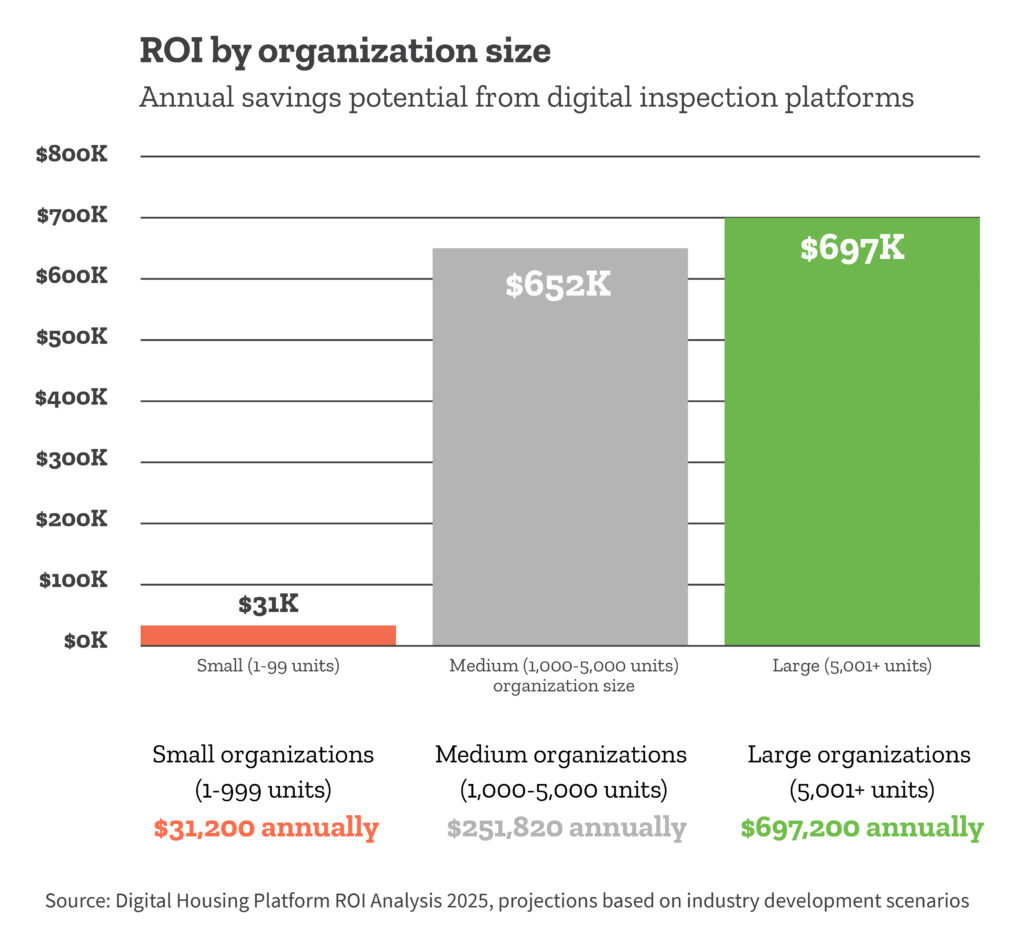
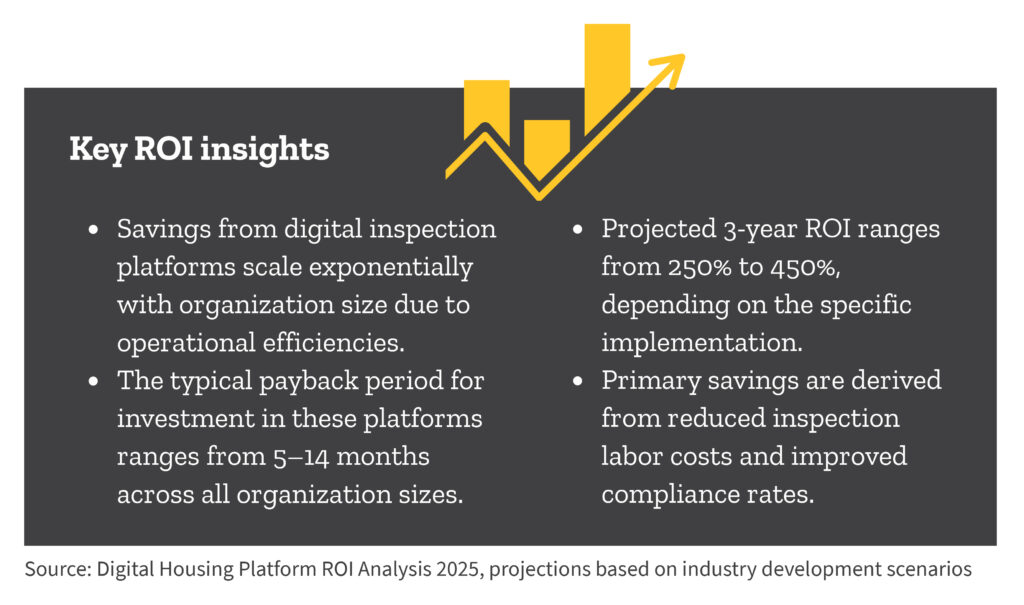
For a medium-sized organization managing 3,000 units, these improvements can translate to annual savings exceeding $250,000 while dramatically reducing compliance risk.
Beyond compliance: strategic advantages
Smart property managers are discovering that NSPIRE compliance technology offers benefits beyond meeting HUD requirements:
Predictive maintenance
Digital platforms can identify patterns that help predict maintenance needs. For example, if data shows that 68% of moisture-related issues occur during seasonal transitions, you can schedule preventive interventions.
Portfolio optimization
Standardized data across properties enables meaningful benchmarking. You can identify your top-performing sites and replicate their practices across your portfolio.
Resident satisfaction
Faster deficiency resolution and better maintenance coordination directly impact resident satisfaction scores—a key factor in HUD’s assessment programs.
Risk management
Comprehensive documentation and automated compliance tracking reduce liability exposure and provide clear audit trails for regulatory reviews.
Looking ahead: the future of housing inspections
NSPIRE is just the beginning. HUD has committed to updating these standards at least once every three years, with additional guidance released as needed. Property managers who invest in flexible, technology-driven solutions will be better positioned for future changes.
Emerging trends include:
- AI-powered deficiency classification that further reduces inspector subjectivity
- Geospatial quality mapping for portfolio-wide condition analysis
- Integration with IoT sensors for real-time monitoring of critical systems
- Blockchain-based audit trails for enhanced documentation security
Organizations that view NSPIRE as an opportunity rather than a burden are positioning themselves to thrive by using this transition to modernize their entire operational approach.
Take action now
NSPIRE compliance isn’t optional—but how you achieve it is your choice. Property managers who continue relying on outdated processes will find themselves at an increasing disadvantage as HUD’s expectations continue to evolve.
The most successful implementations start with a clear assessment of current capabilities, followed by careful selection of technology partners who understand both the regulatory landscape and operational realities of property management.
Don’t wait for the October 2025 deadline to force your hand. The property managers who are preparing for NSPIRE today are building foundations for long-term operational excellence and competitive advantage.

Similar Posts


Features
The art and science of CAM reconciliation
Tips to get an early start on this important property...